What to see in the Capitoline Museums
Five things carry this museum: the Capitoline She-Wolf in the Sala della Lupa, the original bronze Marcus Aurelius in the glazed Esedra, the colossal Constantine fragments in the courtyard, the two Caravaggios in the Pinacoteca, and the Tabularium arcade looking straight down the Roman Forum. Everything else is a bonus, and there is a great deal of it.
Know which one you want? The live dates and the operator’s own price are one tap away.
Check dates & availability →The courtyard, before you have even taken your coat off
You walk into Palazzo dei Conservatori and the first thing in front of you is a head, a hand and a foot the size of furniture. They are what is left of a colossal enthroned Constantine, an acrolith with the flesh in Parian marble and the mantle in gilded bronze sheet, made between AD 313 and 324 and recovered from the Basilica of Maxentius in 1486. The right hand alone is 166 cm. Parts of the statue originally stood about ten metres above the ground. The famous raised index finger is a modern restoration of an ancient fragment — the hand probably held a sceptre shaft. The bronze head, hand and globe that came with the 1471 donation are elsewhere in the building; that donation is the whole reason this place calls itself the oldest public museum in the world.
The She-Wolf, and the argument about her
Upstairs in the Sala della Lupa, a bronze she-wolf 75 cm high, lost-wax cast, shown as an animal that has recently given birth. She arrived on the hill in the 1471 donation and stood on the palace façade before being brought indoors during Michelangelo’s works.
Now the correction, and it is a good one. The museum’s own label still dates the wolf to the 5th century BC and attributes her to Etruscan or Magna Graecia workshops. Anna Maria Carruba argued in 2006 that she was cast in a single piece by a technique not used in classical antiquity but characteristic of the Middle Ages. Radiocarbon dating at the University of Salento then put the manufacture between AD 1021 and 1153 with 95% confidence, and thermoluminescence work published in 2021 constrained it to the 8th to 14th century. The twins underneath her are separately and uncontroversially a Renaissance addition, often attributed to Antonio del Pollaiuolo. So: the label says ancient Etruscan, the laboratory says medieval, and both statements are on the record. I would look at her knowing that.
The Esedra di Marco Aurelio
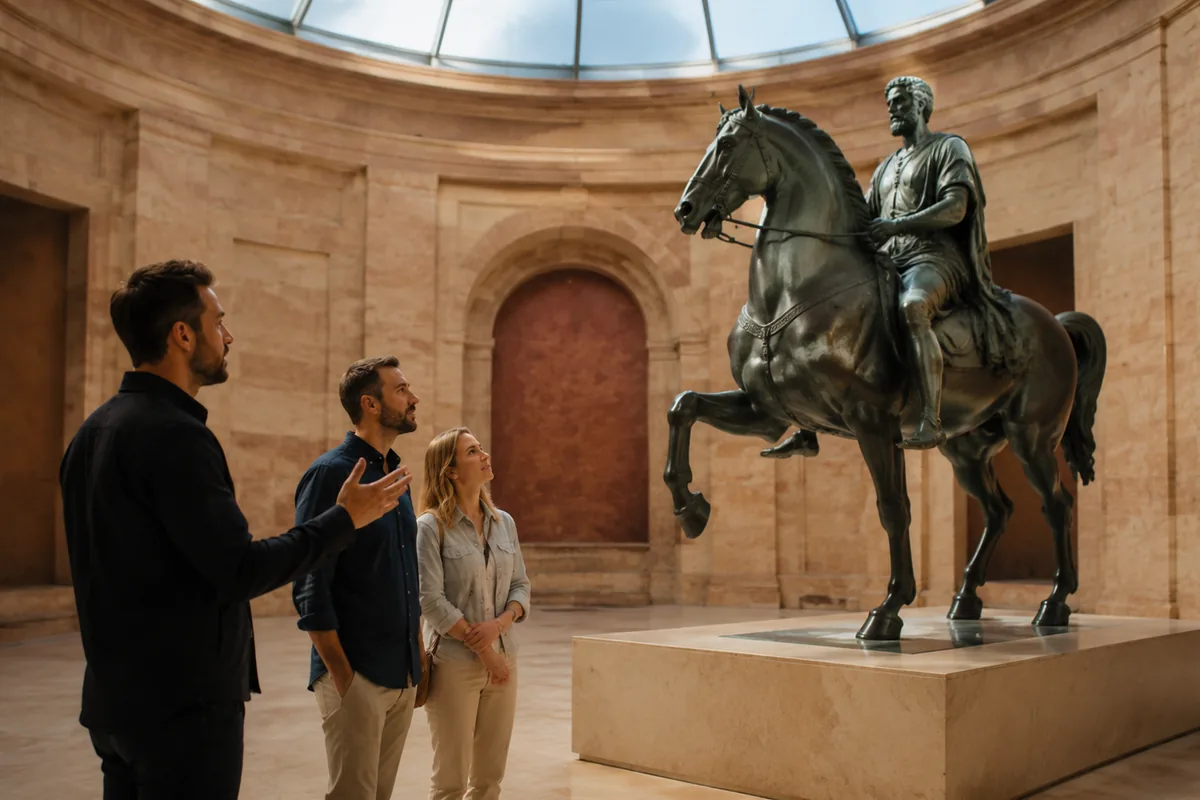
The bronze horseman in the middle of Michelangelo’s square is a copy, put up on the original base on 19 April 1997. The original came in from the Lateran in 1538 by order of Paul III, came down for restoration on 8 January 1981, and returned indoors under glass on 11 April 1990. It stands 424 cm high in a great glazed hall designed by Carlo Aymonino and inaugurated in 2005, along with the gilded bronze Hercules from the Forum Boarium, bronze fragments of a colossal Constantine, and the exposed foundations of the Temple of Jupiter Capitolinus. This room is the single best reason to buy a ticket rather than admire the piazza and walk away — the point I make again on are the Capitoline Museums worth it.
Seeing sculptures I had wanted to see for years, seeing sculptures I had not expected to see there.James_B · Viator
The Sala dei Trionfi bronzes
Three of the 1471 bronzes stand here together. The Spinario, a boy pulling a thorn from his foot, 73 cm, 1st century BC, one of the most copied works of the Renaissance. The Camillo, a young attendant in religious service. And the Capitoline Brutus, 69 cm of bronze portraiture from the 4th to 3rd century BC, donated by Cardinal Pio da Carpi in 1564 — whose traditional identification as Lucius Junius Brutus the museum itself calls “a learned interpretation of antiquarian culture, devoid however of real foundations”. When a museum corrects its own room labels, believe it.
Across the piazza, without going outside
You reach Palazzo Nuovo through the Galleria Lapidaria beneath the square and the Tabularium above the Forum, which is the bit of the visit that surprises everyone and which the layout page describes properly. In Palazzo Nuovo:
- The Dying Gaul in the Sala del Gladiatore — the museum calls it the Galata Capitolino. Docimian marble, about 93 cm, roughly 60–40 BC, a copy after the votive group Attalus I dedicated at Pergamon. A Celtic warrior half-reclining on his own shield, with a torque at his neck and blood from a chest wound. He is deliberately placed with his back to you as you come up the stairs. The room name preserves an identification that was wrong.
- The Capitoline Venus, 193 cm, Roman after a Praxitelean original, found near the Basilica of San Vitale around 1666–1670 and given to the Capitoline by Benedict XIV in 1752. She has her own small cabinet room, which is unusual and very photogenic.
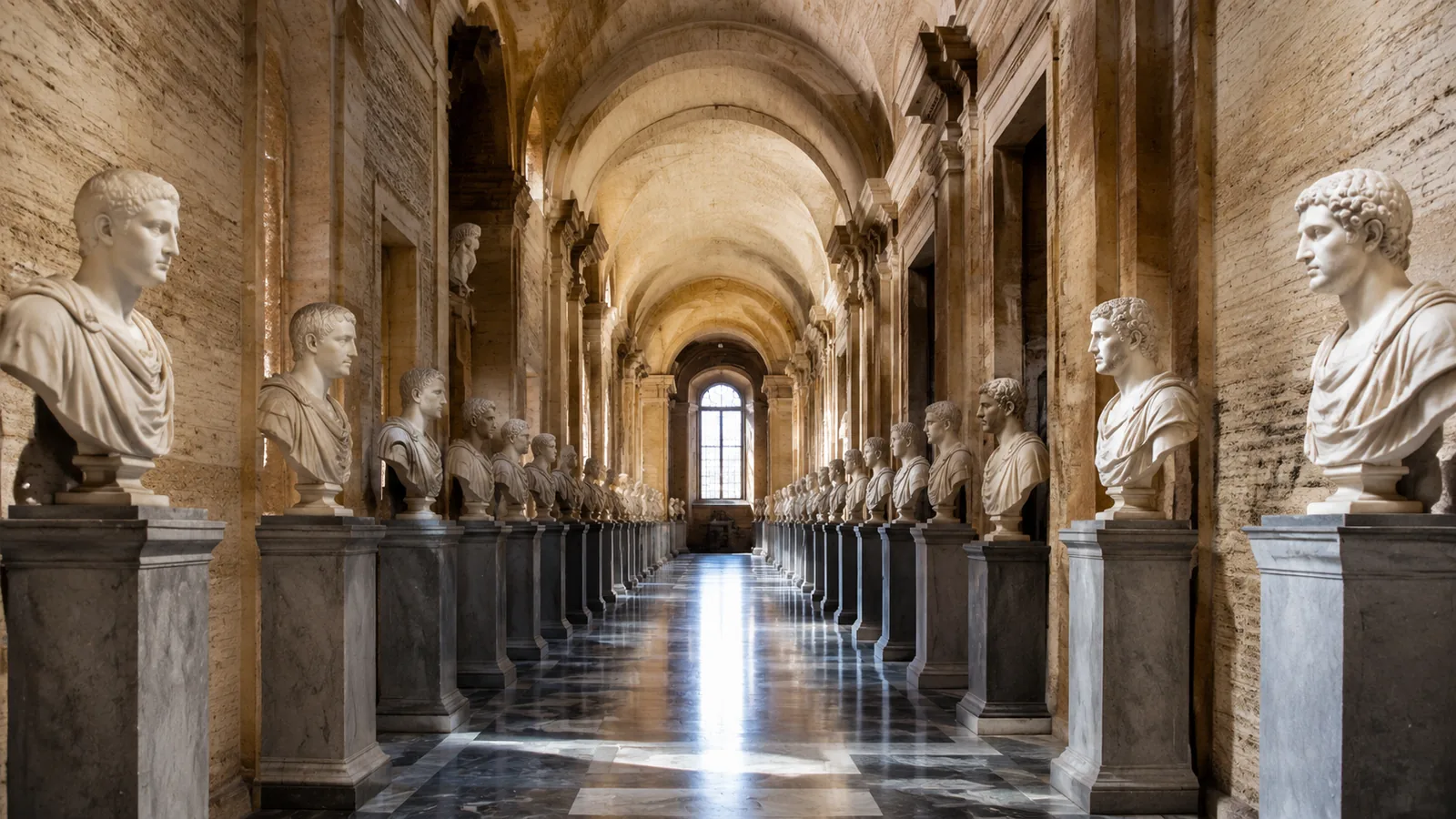
- The Sala degli Imperatori — sixty-seven imperial busts in chronological order on a double row of shelves, most of them from Cardinal Albani’s collection, acquired in 1733. In the middle, a seated Helena, mother of Constantine.
- The Sala dei Filosofi — Homer, Socrates, Cicero, Euripides, Pythagoras, and a double herm of Epicurus and Metrodorus. The museum notes drily that many of these portraits are reconstructions made long after their subjects died.
- The Salone, with the two Furietti centaurs from Hadrian’s Villa and a colossal basanite Heracles as a Child.
- Marforio in the courtyard — a river god of the 1st century AD, one of Rome’s talking statues, to which citizens once pinned satires against papal government.
The Pinacoteca, and an honest word about it
Upstairs in Palazzo dei Conservatori, nine rooms. The Sala di Santa Petronilla holds Caravaggio’s La Buona Ventura of 1596–1597 and his San Giovanni Battista of 1602, Rubens’ Romulus and Remus, Domenichino’s Cumaean Sibyl and the vast Guercino altarpiece the room is named for. Sala III has Titian’s Baptism of Christ and Veronese’s Rape of Europa.
And still: as a picture gallery this is a lesser collection than the Galleria Borghese, and I am not going to pretend otherwise. Go for the Caravaggios and the Guercino, not for a survey. If paintings are what you came to Rome for, read Capitoline or Borghese before you choose.
The room nobody tells you about
The Sala degli Orazi e Curiazi, at the start of the Appartamento dei Conservatori, was the great hall where Rome’s Public Council held its deliberations, frescoed by the Cavalier d’Arpino from 1595 and holding Bernini’s marble Urban VIII and Algardi’s bronze Innocent X. It is also the room where the Treaty of Rome was signed on 25 March 1957 by Belgium, France, West Germany, Italy, Luxembourg and the Netherlands. The museum’s own page for the room does not mention it. You walk through the birthplace of the European Economic Community on your way to look at a wolf.
Finish at the arcade
The Tabularium gallery is eleven bays of Gabine tufa arches with travertine capitals, walled up in the Middle Ages when the structure served as a fortress and only partly reopened since. On its wall sits a huge marble fragment from the Temple of Concordia. Through the arches is the Roman Forum, with the Palatine and the Colosseum behind it. It is a covered, quiet, seated-height view of the Forum that asks nothing of your legs, and almost nobody puts it on a poster. The hill you are looking across at is a different one with a different ticket, which is worth being clear about — see Capitoline Hill or Palatine Hill. Go at opening or in the last hour if you want it to yourself; how busy it gets has the timings.
Individual rooms here close for months at a time — the Pietro da Cortona room and the Horti di Mecenate halls were both shut for works during 2026. If you are coming for one specific object, check the museum’s notices page the morning you go rather than trusting any guide, this one included.
 Most booked
Rome: Capitoline Museums Experience with Multimedia Video
 Art historian
Rome: Capitoline Museums Timeless Private Guided Tour
 Top rated
Rome: Private Capitoline Museums Tour
Frequently asked questions
What is the most famous thing in the Capitoline Museums?
The Capitoline She-Wolf, in the Sala della Lupa — though the original bronze Marcus Aurelius in the Esedra is the more astonishing object in person. The one in the square outside is a replica placed there in 1997. Both sit on the museum’s published list of thirteen masterpieces.
Is the Capitoline She-Wolf really Etruscan?
The museum’s label says 5th century BC, Etruscan or Magna Graecia. Radiocarbon analysis at the University of Salento dated the bronze to between AD 1021 and 1153 with 95% confidence, and thermoluminescence work in 2021 pointed to the 8th to 14th century. The twins are a Renaissance addition. The disagreement is real and both positions are published.
Are the Caravaggios always on display?
Usually, in the Sala di Santa Petronilla, but individual works do come off view for conservation — La Buona Ventura had restricted viewing hours during one week in May 2026. Check the museum’s notices page before travelling for a specific painting.
What is the best view from the museum?
The Tabularium arcade over the Roman Forum, reached underground from the Galleria Lapidaria without going back outside. For a view over the city rather than the Forum, the Terrazza Caffarelli has its own external entrance and needs no museum ticket — see the café and terrace page.
How many rooms are there?
Nine in the Appartamento dei Conservatori, thirteen in Palazzo Nuovo, nine in the Pinacoteca, plus the Galleria Lapidaria, the Tabularium, the Medagliere and the Caffarelli-Clementino sections — eight itinerary sections in all. The layout page puts them in order.