Visiting the Capitoline Museums with children
It works better than most Roman museums, for three practical reasons: children under six go in free, prams and strollers are permitted throughout, and the museum is full of objects a child can actually see the point of — a wolf feeding two babies, a hand the size of a sofa, a dying warrior, sixty-seven emperors in a row. It also runs to two to three hours, which is about the limit anyway, and nothing forces you to stay.
Know which one you want? The live dates and the operator’s own price are one tap away.
Check dates & availability →What actually holds their attention
I have taken enough visiting nieces round this building to have a route. In order:
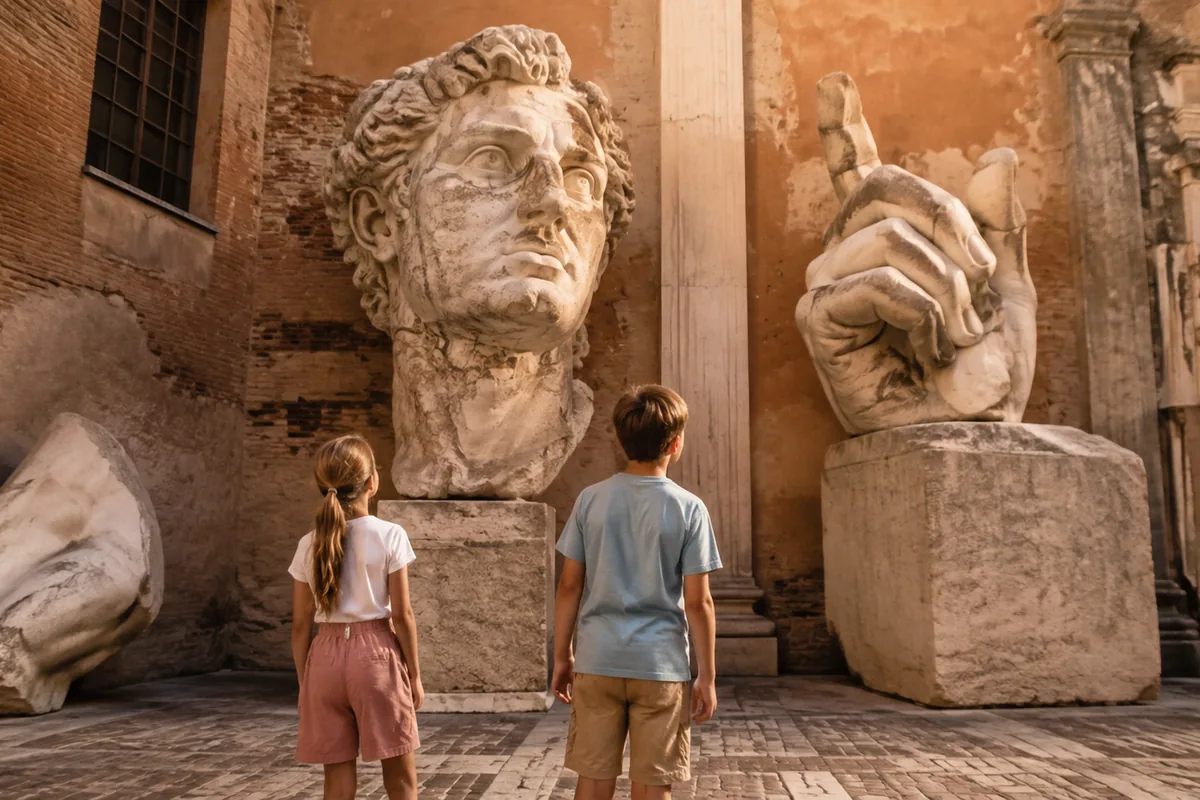
- The courtyard, straight away. Constantine’s head, hand and foot, in the open air, with no glass. The right hand alone is 166 cm. Nothing else in the museum needs less explanation.
- The She-Wolf in the Sala della Lupa — the Romulus and Remus story in one object, and a good moment to mention that the twins were added about 1,500 years after the wolf, which children find funnier than adults do.
- The Spinario, a boy about their age pulling a thorn out of his foot. It works every time.
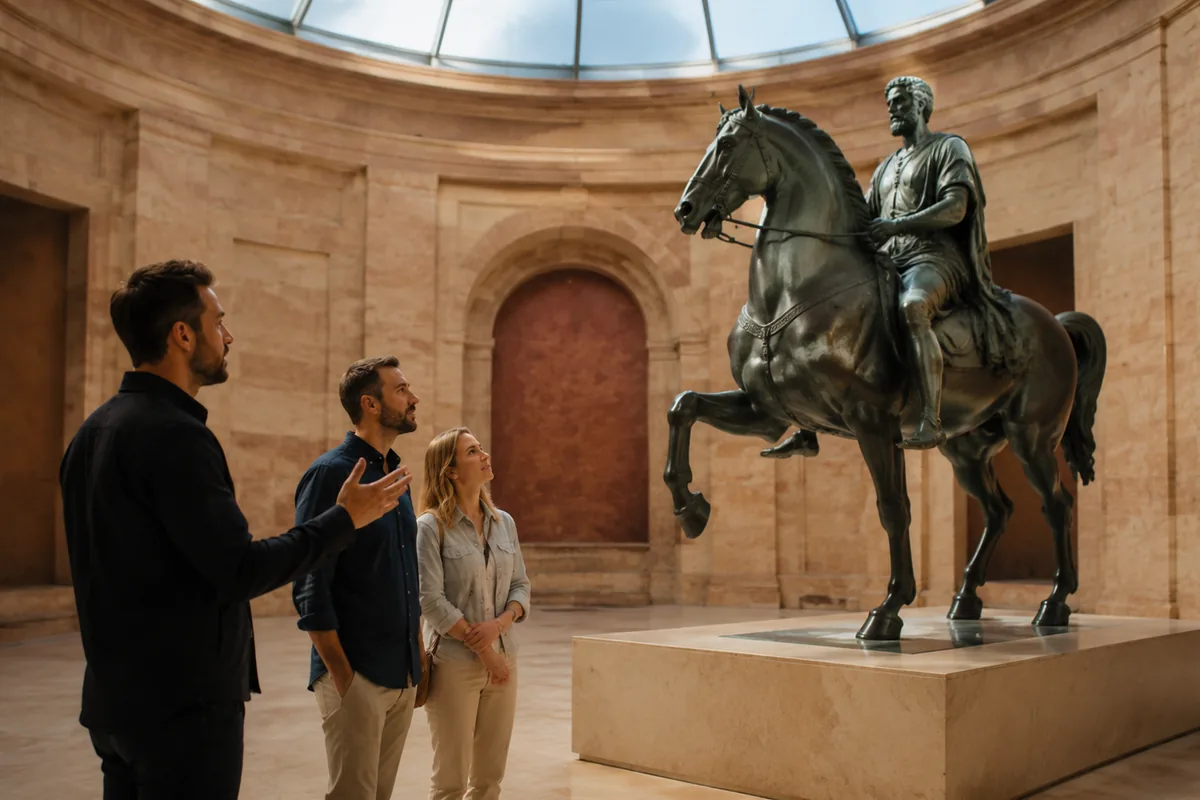
- The Marcus Aurelius bronze in the Esedra, which is enormous and shiny and has a horse.
- The Dying Gaul, which is gory enough to hold an eight-year-old.
- Marforio in the courtyard of Palazzo Nuovo — a talking statue that Romans used to pin insults about the pope to. Children like the idea of a statue used as a noticeboard for complaints.
- The Tabularium arcade at the end, where the Forum appears below you like a model village.
What I would skip with children under about ten: the Pinacoteca, the Galleria Lapidaria and the Sala dei Filosofi. All three are excellent and none of them is for them. The full route is on what to see, and the timing options on how long you need.
The tour that is genuinely built for them
There is a private Percy Jackson tour of the museums, two and a half hours, for up to four people, in English, Spanish or Portuguese, with mythology storytelling built around the books and an interactive quest for the children. It meets in front of the ticket office at Piazza del Campidoglio 1 and includes entry and skip-the-ticket-line access. It rates 4.7 from 46 reviews, and the reviews are unusually specific.
For our daughter, this tour was the absolute highlight of our time in Rome.Jane, Germany · GetYourGuide
Juanita from Malta wrote that Silvano was highly knowledgeable and great with engaging kids and adults alike. Carla from the United States said it was cool to see how much her son knew and how he related to the guide, and Charles from the United Kingdom found Vivi pleasant, friendly and knowledgeable. That is the pattern across the whole review set: the storytelling premise gives a child a reason to look at a statue. More of them on the review page, and the family options are compared on tours for families.
If your children are too young for a two-and-a-half-hour tour, buy the plain ticket and the children’s audioguide at the desk, and give yourself ninety minutes. This is a museum you can leave whenever you like, which is worth more with a four-year-old than any itinerary.
The practical side
Usually included
- Children under six enter free; non-residents aged 6 to 25 fall into the reduced band
- Prams and strollers are permitted throughout the museum
- A dedicated children’s audioguide is available
- Accessible bathrooms and restrooms through the complex
- The terrace café upstairs, reachable by its own external entrance for a break
- Two courtyards where a child can be loud without anyone minding
Not included
- Food and drink in the galleries
- Bulky bags and backpacks — use the cloakroom
- A quick exit from the middle of the route; plan the Tabularium as your finish
- Step-free access to every part, particularly at present in Palazzo Nuovo
Two warnings worth reading before you book
First, the family tour caps at four participants. A group of five needs a different product, and the art-historian tour, though sold as private, has a booking cap of twenty — not the same thing at all. Second, the audioguide product states that large bags and luggage are not allowed and that it is not suitable for visitors with mobility impairments, which rules it out for some families arriving straight off a train. The comparison across all six is on the tickets hub.
Making a day of it
The hill itself is free and children like it: Michelangelo’s star pavement, the two basalt lions at the bottom of the Cordonata, the Dioscuri at the top, and the 13-metre reconstruction of the Colossus of Constantine standing in the Giardino di Villa Caffarelli, which costs nothing and is the single most photographed thing on the hill among the under-twelves. Afterwards, the Ghetto is a short walk downhill for lunch — see where to eat nearby. And it is open on Mondays, when the Borghese is not, which matters when a school holiday falls awkwardly: what is open in Rome on a Monday.
 Best with kids
Rome: Private Percy Jackson Tour at Capitoline Museums
 Top rated
Rome: Private Capitoline Museums Tour
Frequently asked questions
Are the Capitoline Museums good for children?
Better than most. The objects are large, strange and easy to explain — the She-Wolf, Constantine’s colossal hand, the Marcus Aurelius bronze — and the visit runs two to three hours with no fixed slot, so you can leave when they have had enough.
Do children pay to enter?
Children under six years old go free. Non-residents aged 6 to 25 fall into the reduced category. The full list of who pays nothing is on free entry.
Can I take a pushchair inside?
Yes. Prams and strollers are permitted throughout the museum, which is more generous than many Roman museums. Bulky bags and backpacks are not, and go in the cloakroom.
Which tour works best with kids?
The private Percy Jackson mythology tour: 2.5 hours, up to four people, an interactive quest, 4.7 from 46 reviews, meeting in front of the ticket office. See its review page for what parents actually said.